In April, MSU undergraduate students presented their research with MSU HDFS faculty, grad students and labs at the 2026 University Undergraduate Research and Arts Forum (UURAF) at the Breslin Center.
UURAF provides Michigan State University undergraduate students with an opportunity to showcase their scholarship and creative activity. Held each spring, UURAF brings together an intellectual community of undergraduate students to share their work with faculty, staff, peers, and external audiences.
Participants gain experience in presenting their research, answer questions about their work from audience members and guests and receive constructive feedback from judges.
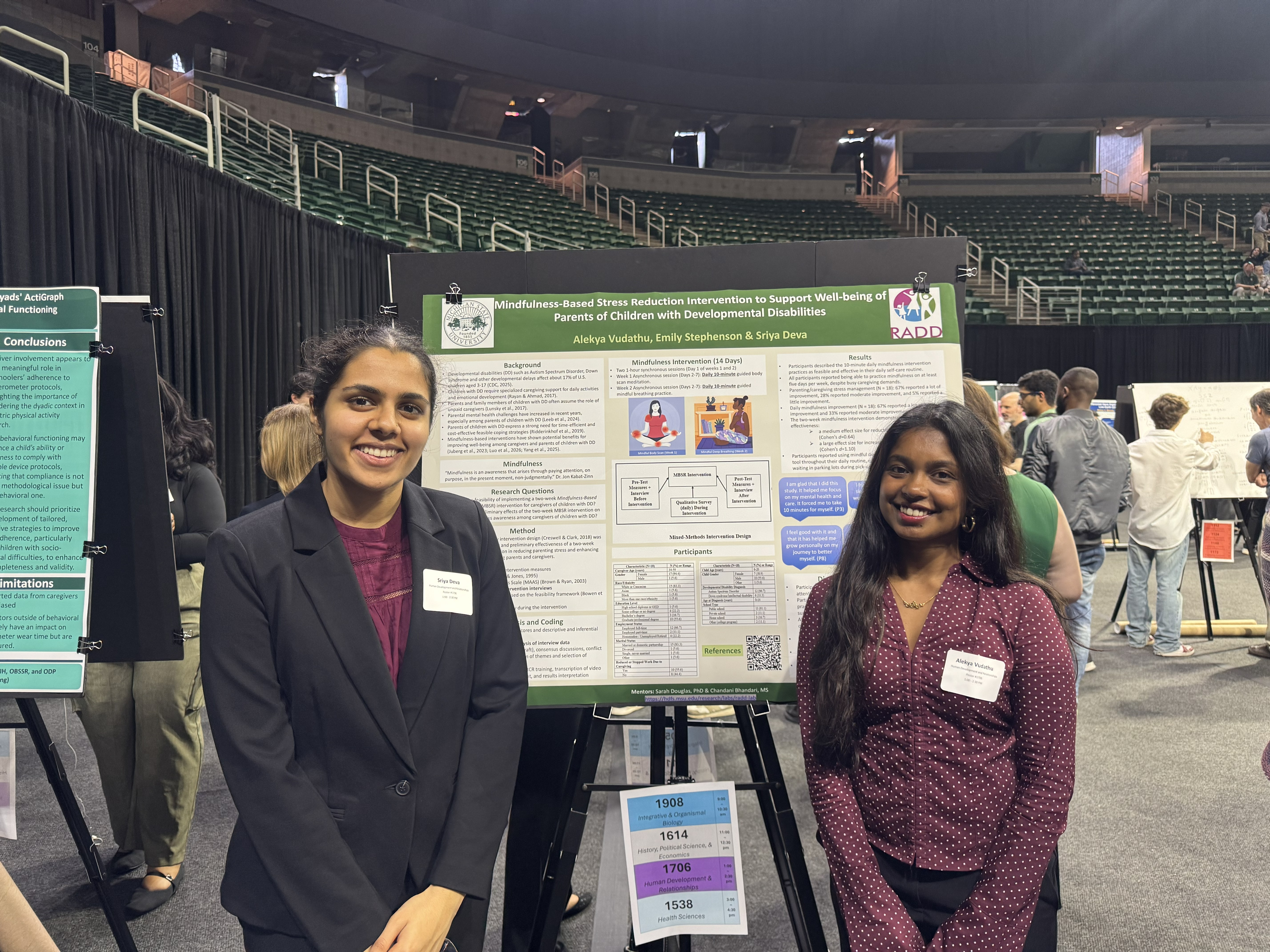
Sriya Deva, Emily Stephenson and Alekya Vudathu presented their research, “Mindfulness Intervention to Support Well-Being of Parents of Children with Developmental Disabilities.”
“I learned that there is a need for an intervention to help caregivers decrease their stress while they care for their children with developmental disabilities or who are on the autism spectrum,” Alekya said. “Doing this research helped me learn the many different methods to alleviate stress, starting with mindfulness. We implemented a body scan and meditation into their daily routines, and I learned that that can significantly improve stress in their daily life.”
“Something that I learned from this research is how to analyze transcripts and themes among the parents, and being able to see how exactly mindfulness has an impact on lowering their stress levels,” Sriya said.
Their advisor was Dr. Sarah Douglas, MSU HDFS professor, their mentor was HDFS graduate student Chandani Bhandari, and their work was in connection with the MSU Research in Autism and Developmental Disabilities (RADD) Lab.
“Mentoring Alekya, Emily and Sriya in the RADD Lab was an amazing experience,” Bhandari said. “It was inspiring to see their research skills develop and grow throughout the project. They also presented their work at UURAF 2026 and I'm so proud of the wonderful work they have done.”
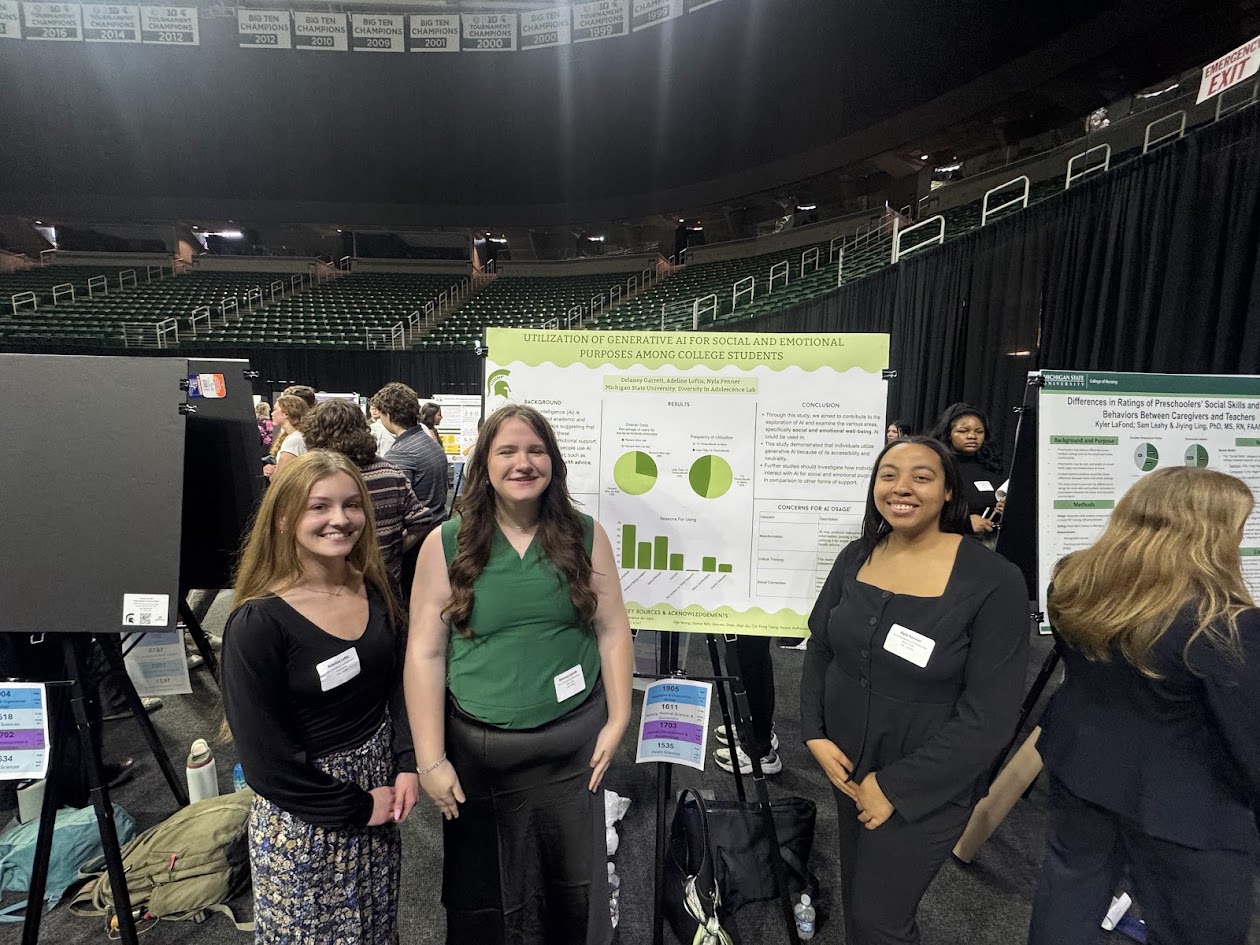
Nyla Fenner, Delaney Garrett and Adeline Loftis presented their research, “Utilization of Generative AI for Social and Emotional Purposes Among College Students.”
“One thing I learned from this research is how people utilize AI and that one of the main reasons they use it is that it’s available all the time,” Nyla said.
“One thing I learned from my research was about the different types of AI that people use in their day-to-day lives and how frequently it’s used,” Delaney said. “Most people use AI for social-emotional purposes one to two times per month, so that was something very interesting to find.”
“I learned that AI is used so widespread between college students, mostly because it’s so available and accessible and neutral, and because it eliminates the fear of being judged,” Adeline said.
Their advisor was Dr. Yijie Wang, MSU HDFS associate professor, and their research was in connection to the Diversity in Adolescence Lab.
“It has been an absolute joy to work with my undergraduate research team on this project,” Dr. Wang said. “They have been involved every step of the way—from the earliest stages of developing the idea and designing the study to helping analyze the data. Along the way, they brought thoughtful insights and lived experiences that truly shaped the project in meaningful ways. Watching them present this work at UURAF, knowing how much they contributed to it, was incredibly rewarding and honestly one of the most meaningful parts of the experience for me!”
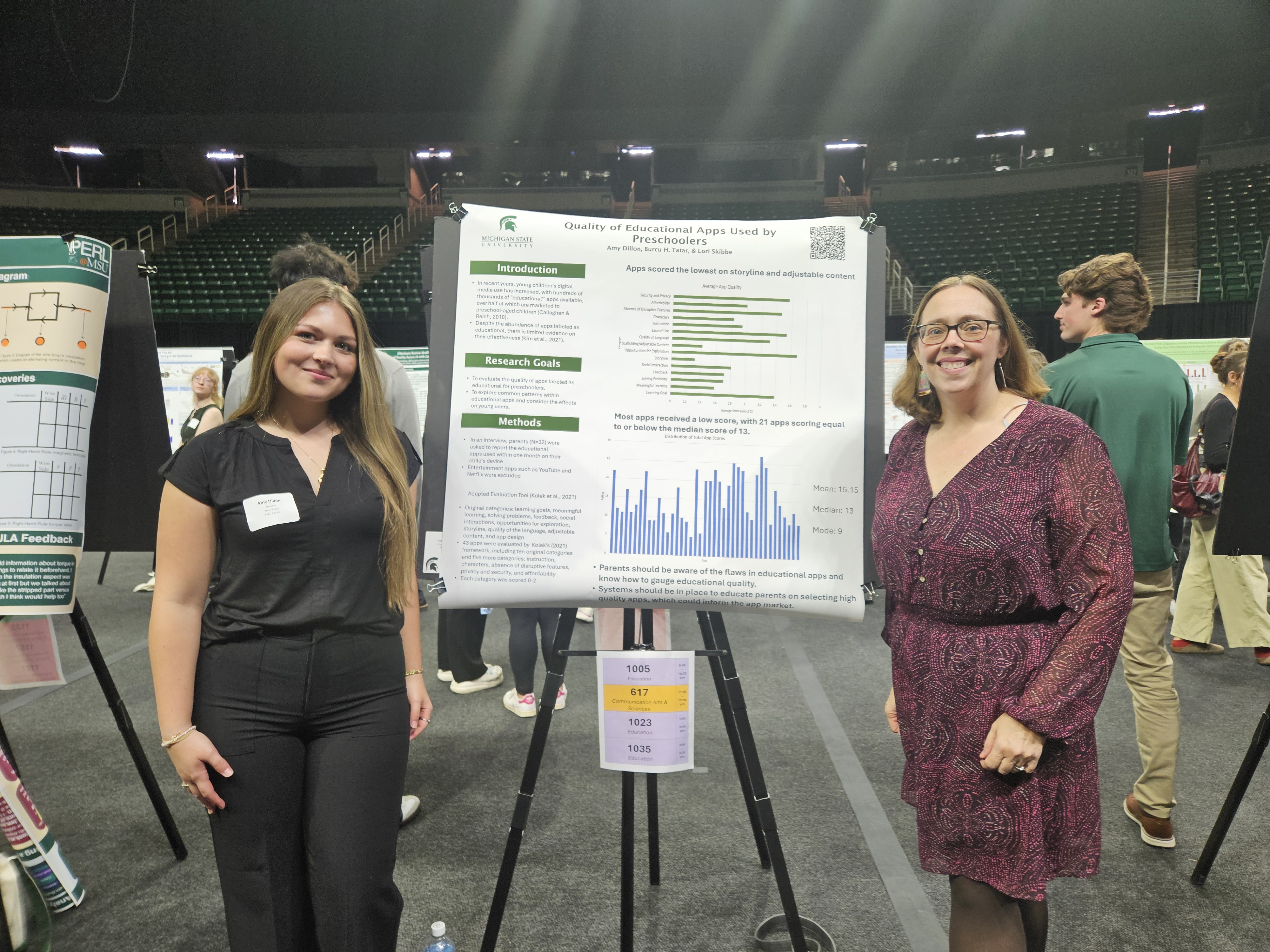
Amy Dillon worked with advisor Dr. Lori Skibbe on her project, “The Quality of Educational Apps Parents Report Providing to Their Preschoolers,” as part of the research of the Early Literacy and Language Investigations Research Group.
“We looked at the educational apps that preschoolers are using and we evaluated 42 different apps across 15 categories.” Amy Dillon said. “We found that unfortunately many apps are low- to mid-quality, which can have negative effects on children as they grow. We recommend to parents to learn about what makes an app high or low quality and what can affect its educational value. This could also have implications for researchers to create a tool that allows parents to evaluate an app’s quality or to get an opinion from experts in the field, and that way they can decide if an app is appropriate or beneficial for their child. We also recommend to app developers to use children’s learning as a foundation and to design apps that are based on their learning that will benefit them in the long run rather than just engaging them for the short term.”
“Working with Amy was really fun,” Burcu Ozkum said, graduate student and Amy’s mentor. “We got to explore and play around with the apps together to evaluate app quality. We aimed to understand whether the apps parents downloaded for their children have educational potential. She made thoughtful contributions on how we approach app quality evaluation. Her research informs parents on how to select apps and the app industry on creating apps that better support children’s learning."
“Amy's work shows how important it is to look at the quality of the educational apps that preschoolers use,” Dr. Lori Skibbe said. “Many of the apps she studied were of low quality. Amy was able to identify several areas that app developers could use to improve their products, like improving feedback to children and providing ways to make content more adjustable in terms of difficulty."
To learn more about getting involved in HDFS research, visit our HDFS research page.